 HYPERIGS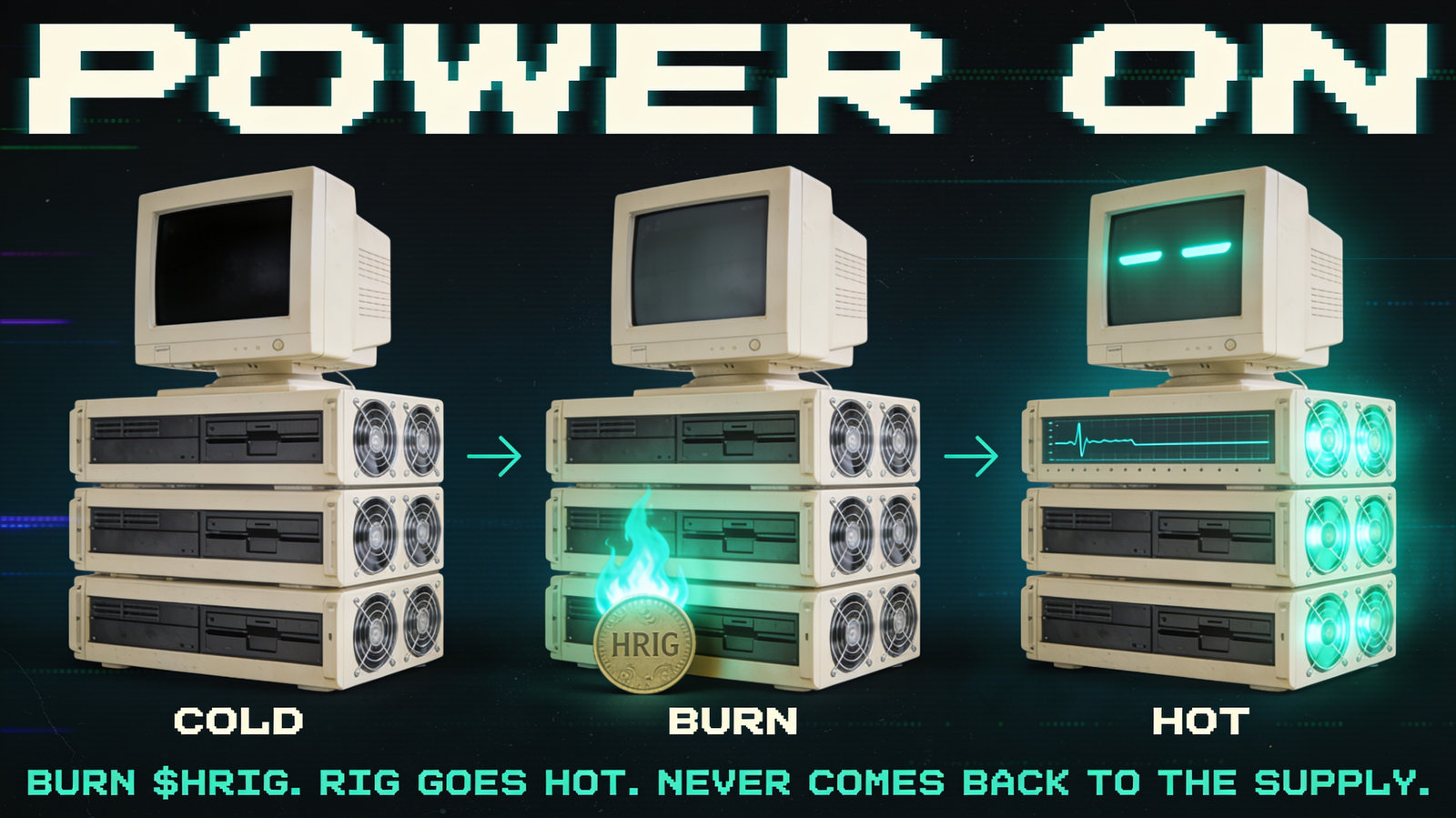
Overview
HYPERIGS is a hashrate pool on HyperEVM built around 6,666 mining rigs. A rig is both a token and a machine: 1 $HRIG = 1 RIG. Burning the token behind a rig powers it on. Powered-on rigs contribute hashrate, and hashrate is the only thing that decides how much of the pool each rig receives.
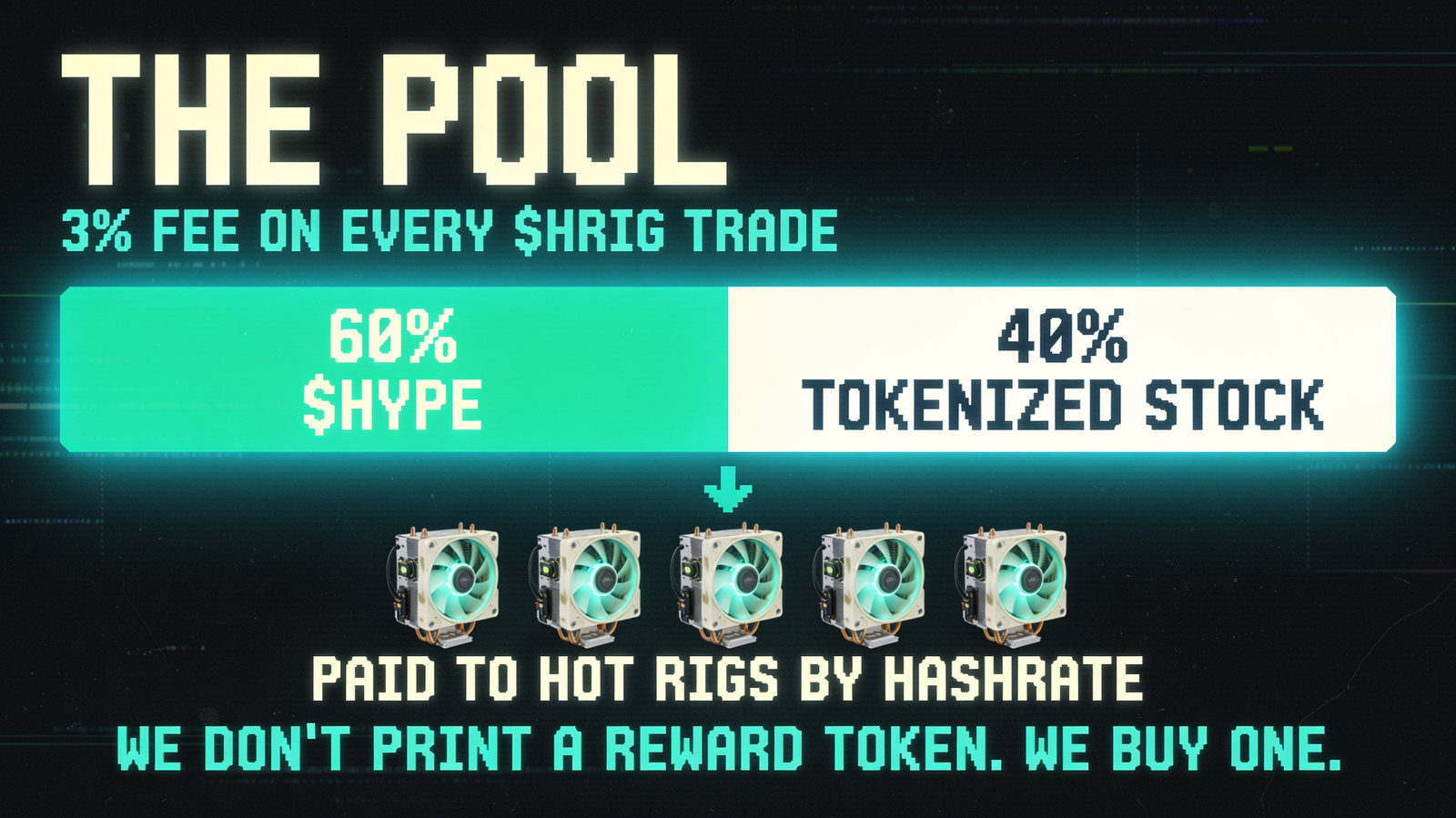
The pool is funded by a 3% protocol fee on every $HRIG trade. It does not mint anything. It buys $HYPE and tokenized stock on the open market and distributes them to hot rigs every six hours.
What the protocol is
- One token with a hard cap of 6,666 and no minting function after deploy.
- A burn-to-hardwire mechanic that converts liquid tokens into non-fungible hot rigs.
- A fee router that turns trading volume into a basket of $HYPE and tokenized stock.
- A distributor that pays that basket out to hot rigs, pro rata by hashrate, every shift.
What it is not
- Not a yield token. There is no second token and no emissions schedule.
- Not a rarity game. Traits are cosmetic; hashrate is earned by behaviour, not rolled at mint.
- Not a treasury the team controls. Fees route into the pool contract, not a multisig.
The token
| Name | HYPERIGS |
|---|---|
| Ticker | $HRIG |
| Standard | Fungible token and NFT in a single contract |
| Chain | HyperEVM |
| Max supply | 6,666 — fixed at deploy, no mint function |
| Decimals | 18 (token side) |
| Protocol fee | 3% on every buy and sell, routed to the pool |
| Team allocation | 0 |
| LP | Seeded at launch, LP tokens burned |
How the token behaves here
Whole units of $HRIG carry an NFT. Hold 3.0 $HRIG and your wallet holds three cold rigs. Sell 0.5 and one of those rigs is burned back into fractions — the token is still yours, the machine shape is gone until you own a whole unit again. Buying back over a whole unit mints a fresh cold rig with a fresh ID.
Only cold rigs behave this way. A hot rig has had its token burned; it is a plain NFT and can no longer be fractioned. This is what "never comes back to the supply" means.
Quickstart
- Get $HYPE on HyperEVM.
- Swap $HYPE for at least 1.0 $HRIG in the Swap tab. A cold rig appears in your wallet.
- Open Rigs, press Power on. The $HRIG behind that rig is burned; the rig goes hot.
- Wait for the next shift. Your rig's hashrate earns its share of the pool.
- Claim in the Pool tab whenever you like. Unclaimed rewards accrue.
Power on
Power on is the only way a rig starts earning. It is a burn: the whole $HRIG unit behind the rig is destroyed, the NFT is flagged hot, and its hashrate is registered with the distributor from the next shift.
Consequences
- Circulating $HRIG only goes down. Every power-on removes one whole token forever.
- A hot rig cannot be fractioned. It trades only as an NFT, on NFT venues.
- The rig keeps its ID, rack and traits. Nothing visual changes except the screen turning on.
- There is no undo. Powering down does not return the token (see Power down).
Hashrate
Hashrate is a unitless weight, displayed as TH/s for flavour. Every distribution splits the shift's payout across all hot rigs in proportion to hashrate at settlement.
hashrate(rig) = BASE × UPTIME(rig) × OVERCLOCK(rig)

BASE      = 1.00                       same for every rig
UPTIME    = min(1.60, 1.00 + 0.02 × days_hot)
OVERCLOCK = min(3.00, 1.00 + 0.50 × extra_burns)
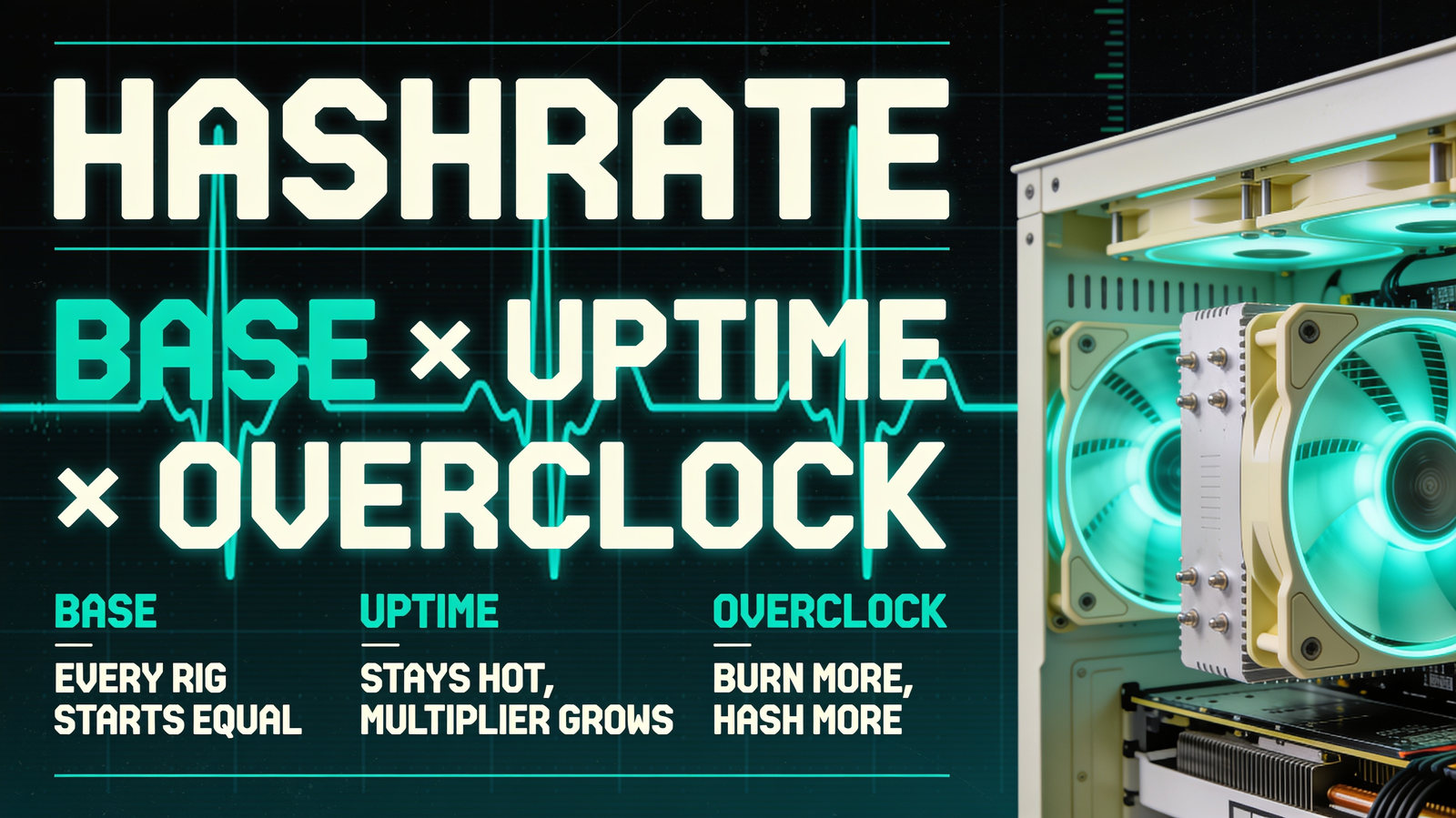
A brand-new hot rig hashes at exactly 1.00. The theoretical maximum for a single rig is 1.60 × 3.00 = 4.80: thirty days of uninterrupted uptime plus four overclock burns. Two floor rigs will always out-hash one maxed rig on day one; one maxed rig out-hashes four fresh ones. That is the whole strategy space.
Worked example
| Rig | Days hot | Extra burns | Uptime | Overclock | Hashrate |
|---|---|---|---|---|---|
| #0451 | 0 | 0 | 1.00 | 1.00 | 1.00 |
| #1337 | 12 | 0 | 1.24 | 1.00 | 1.24 |
| #0088 | 12 | 2 | 1.24 | 2.00 | 2.48 |
| #6666 | 45 | 4 | 1.60 | 3.00 | 4.80 |
If those four were the only hot rigs, #6666 would take 4.80 / 9.52 = 50.4% of the shift.
Uptime
Uptime rewards not touching the machine. The multiplier grows +0.02 per full day a rig stays hot in the same wallet, and caps at 1.60× after 30 days.
- Counted in whole days from the shift the rig went hot.
- Resets to 1.00 on any transfer. Selling a hot rig sells the machine, not the run.
- Does not reset on claiming rewards. Claiming is free of side effects.
- Does not reset on overclocking. Burning more into a rig is not a transfer.
The cap exists so a whale who powered on in week one cannot become permanently unbeatable. After 30 days every long-running rig is equal again, and only overclock separates them.
Overclock
Overclock is the second burn. Send an extra whole $HRIG into a rig that is already hot and its multiplier rises +0.50×, permanently, up to 3.00× (four extra burns).
- Overclock stays with the rig through transfers. A 3.00× rig sold on a marketplace is still a 3.00× rig.
- Each overclock burn removes another whole $HRIG from supply.
- It is optional. A protocol where every rig is equal at 1.00 works fine; overclock is for people who want to concentrate.
Overclock vs. more rigs
One $HRIG burned as overclock adds 0.50 hashrate (×uptime). One $HRIG burned as a new rig adds 1.00 hashrate at uptime 1.00. Overclock is therefore the worse use of a token on day one — until you account for the uptime you already accumulated. Overclocking a 1.60× rig adds 0.80. That is the trade-off: concentrate on a proven rig, or spread and start new clocks.
The pool
The pool is a contract, not a wallet. Every $HRIG swap through the official pair pays a 3% fee to it. On each shift the fee balance is converted:
| Share | Buys | Why |
|---|---|---|
| 60% | $HYPE | The chain's own asset. Liquid, native, no wrapper risk. |
| 40% | Tokenized stock | Equities issued on HyperEVM. The pool holds a rotating basket; the composition is published every shift. |
Basket rules
- Only tokenized stocks with a live on-chain price feed and open redemption are eligible.
- No single ticker exceeds 40% of the stock leg at purchase time.
- The basket is rebalanced by purchases, never by selling. The pool does not trade.
- Distributed assets are sent as-is. You receive $HYPE and the stock tokens themselves, not a synthetic.
Shifts & claims
A shift is six hours. Shifts settle at 00:00, 06:00, 12:00 and 18:00 UTC. At settlement the distributor:
- Snapshots every hot rig's hashrate.
- Converts the fees collected since the last settlement into the 60/40 basket.
- Credits each rig its pro-rata share of the basket.
Credits sit in the distributor until claimed. Claiming is a single transaction per wallet, covers every rig you hold, and has no effect on uptime. There is no expiry. There is no auto-compounding — rewards are not $HRIG and cannot be.
Edge cases
- A rig powered on mid-shift starts earning from the next settlement.
- A rig transferred mid-shift is credited to whoever holds it at settlement.
- If a shift collects zero fees, nothing is distributed and nothing is lost.
Power down & transfers
There is no power-down function. A hot rig stays hot until it changes hands. Selling or transferring it is the only way to "power down", and what actually happens is:
- The rig stays hot and keeps its overclock.
- Uptime resets to 1.00× for the new holder.
- Unclaimed rewards stay with the previous holder's wallet — claim before you sell.
The token you burned is gone regardless. What you sell is a machine with a track record.
Racks & traits
The 6,666 rigs are assigned to six racks of 1,111 by ID. Rack decides the model family; within a rack, traits vary.
| Trait | Values |
|---|---|
| Bays | 2 · 3 · 4 |
| Head | box · small · wide (letterbox) |
| Fans | two per bay · one large per bay |
| Shell | ivory · yellowed · bone · graphite |
| Phosphor | mint · amber |
| Wear | clean · scuffed · taped |
None of these touch hashrate. A taped-up yellowed two-bay with an amber tube hashes exactly like a clean four-bay tower. Rarity is for the eyes and the secondary market, not the pool.
Genesis rigs
Six one-of-one prototypes, one per rack, IDs 0001–0006. Hand-built variants outside the trait table: cracked tube, exposed backplane, brass plate. Same base hashrate as every other rig.
Raffle
- Genesis rigs are not sold. They are raffled at the end of launch week.
- Every hot rig at the closing snapshot is one ticket. Six tickets are drawn, one per rack, from that rack's hot rigs.
- A drawn ticket's holder receives the Genesis rig already powered on.
- Draw uses the block hash of a pre-announced block. Published in advance, verifiable after.
What is not here
- No second reward token. The pool pays in assets that existed before us.
- No emissions schedule. Supply only decreases.
- No blacklist, no pause, no transfer tax. The token contract has no owner-only switches on transfers.
- No dev allocation, no vesting. The team buys like everyone else.
- LP burned at launch. The initial pair cannot be pulled.
- No treasury discretion. Fees route on-chain to the pool; the basket rules are code.
Contracts
| Contract | Address | Notes |
|---|---|---|
| $HRIG | TBA | token + rigs, fee hook |
| Pool | TBA | receives fees, executes basket buys |
| Distributor | TBA | hashrate registry, shifts, claims |
| $HRIG / HYPE pair | TBA | LP burned |
Addresses are published here and pinned on X the moment they are live. Anything claiming to be HYPERIGS before that is not.
Admin surface
The only privileged functions are: adding or removing a tokenized stock from the eligible list, and pausing the basket purchase (not transfers, not claims) if a price feed fails. Both are timelocked 48 hours and logged.
Launch
- $HRIG deployed on HyperEVM, 6,666 supply, LP seeded and burned.
- Trading opens. Fee routing to the pool is live from the first swap.
- Power on opens with the first settled shift.
- Launch week runs seven days — 28 shifts.
- Closing snapshot: Genesis raffle.
Risks
- Smart-contract risk. The contracts are new. Audit status is published on this page.
- Price-feed risk. Tokenized stock relies on issuers and oracles. A failed feed pauses purchases for that ticker; it does not touch what is already distributed.
- Liquidity risk. Hot rigs trade as NFTs. NFT markets are thinner than token markets.
- Fee dependence. The pool grows with trading volume. No volume, no distribution.
- Irreversibility. Every burn is final.
None of this is financial advice. Machines run hot.
FAQ
Can I power on a fraction of a rig?
No. Power on needs a whole unit. Fractions are just tokens.
Do I need to claim every shift?
No. Credits accrue indefinitely. Claim when gas makes sense.
What if the pool buys a stock I don't want?
You receive the stock tokens themselves and can sell them anywhere they trade. The pool never holds your rewards on your behalf beyond the claim.
Can the team change the 60/40?
No. The split is a constant in the pool contract.
Why 6,666?
Six racks of 1,111. And it looks right on a CRT.
Glossary
| Term | Meaning |
|---|---|
| Rig | One of 6,666 machines. Also one whole $HRIG when cold. |
| Cold | A rig that is still a token. Earns nothing. Can be fractioned. |
| Hot | A rig whose token has been burned. Earns hashrate. NFT only. |
| Power on | Burn the $HRIG behind a rig to make it hot. |
| Hashrate | A rig's weight in distributions. base × uptime × overclock. |
| Uptime | Multiplier for consecutive days hot in one wallet. +0.02/day, cap 1.60. |
| Overclock | Extra $HRIG burned into a hot rig. +0.50 each, cap 3.00. Permanent. |
| The pool | Contract that receives the 3% fee and buys the 60/40 basket. |
| Shift | Six-hour settlement window. Four a day. |
| Rack | One of six model families of 1,111 rigs. Cosmetic. |
| Genesis | Six 1-of-1 prototype rigs, raffled to hot rigs after launch week. |